Monday, April 16, 2012

TOYS!, Part 2

Getting the bush hog OFF the tractor was almost as hard as I expected. In the end, I used the motorcycle jack to lift the bush hog to where we could find enough slack in the lift arm to get it OFF the lift arm pin. Now I've turned that pin IN, so we have a foot of slack we didn't have before.

It WAS like this:
-|   |-
Now it is like THIS:
|-  |-
And it may be like this in the future:
|- -|
Now, I had previously decided to NOT change the oil in the tiller's gearbox. It was cloudy, but not terribly discolored. Then I ran across a reference to white grease coming out of u-joints, and how this was caused by an emulsion of the oil and water. My oil looked like caramel milk, which didn't seem good. So, I changed the oil. I probably need to replace a gasket somewhere, too. But before I can do that, I need to know what MODEL my tiller is...

Then we mounted the tiller.

That is, we TRIED to mount the tiller.

We couldn't get the drive shaft mounted to the PTO. It didn't work.

So, we tried separating the halves of the drive shaft and hooking it up, then sliding the two ends together. It didn't work. The tiller just rolled away from the slowly-backing tractor, and the telescoping part of the shaft, wouldn't. Even after we oiled and greased it some more.

So, we tried to take the drive shaft back OFF the tractor. It didn't work. It was well and truly STUCK.

What to do?
Off to the local home improvement store, where we bought a 36" Stanley Ripping Bar. It is -just- too short to make a good cane for me. Too heavy, anyway.

Then, wedge the crowbar between the tractor and the neck of the drive shaft; pull back the collar of the drive shaft; and LEAN HARD into the end of the crow.

I've got about 6" below the fulcrum (the pin for the top bar), and about 30" above it. That means if I put 100 lbs of force into the bar, I should be putting about 500 lbs of force against the neck of the drive shaft.

At first, nothing happened. The CROWBAR was actually visibly flexing. Then, with a PING!, the drive shaft popped off the PTO, right out of my hands. I think it took somewhere between 500 and 1000 lbs of applied force, which I would NOT have been able to get any other way.

At this time, the neck and collar of the PTO are soaking in motor oil. They'll be there at least two more days, because WE GOT OUR TREES.

Thursday, April 12, 2012

Sadie the Dog


As promised! According to the vet, Sadie's kidney values are the lowest they have ever seen them. She is absolutely normal! Our next follow-up appointment will be in early OCTOBER!

Sunday, April 8, 2012

Potato Barrels, Part 2

Here is evidence of life in the potato barrels!!

Happy Easter!

It's been a busy weekend here at Honeyhill...

On Saturday, we got to try out the bush hog, and it WHACKS down weeds and brambles. If you set it too low, it's a pretty good plow. There's a section I scalped so well, I'm thinking we'll just till it and plant flowers.

But it is a BEAR to get it on and off the tractor, and I intend to make some unapproved mods to make that easier--pointing the lift arm pins in the other direction, mostly. They're so wide, I had to take one lift arm OFF to get it in place, and I'll have to reverse that to get it off again.

I started Saturday mowing down the grass around our 2 existing peach trees. We've lived here over 2 years, and have yet to taste a peach! But the Japanese beetle grubs have had a wonderful time! (Well, so has Sadie the dog--she discovered the wonders of fermenting peach juice, and it was all we could do to keep her away from the fallen fruit...) So after mowing the grass about 30 feet in all directions from the trees...


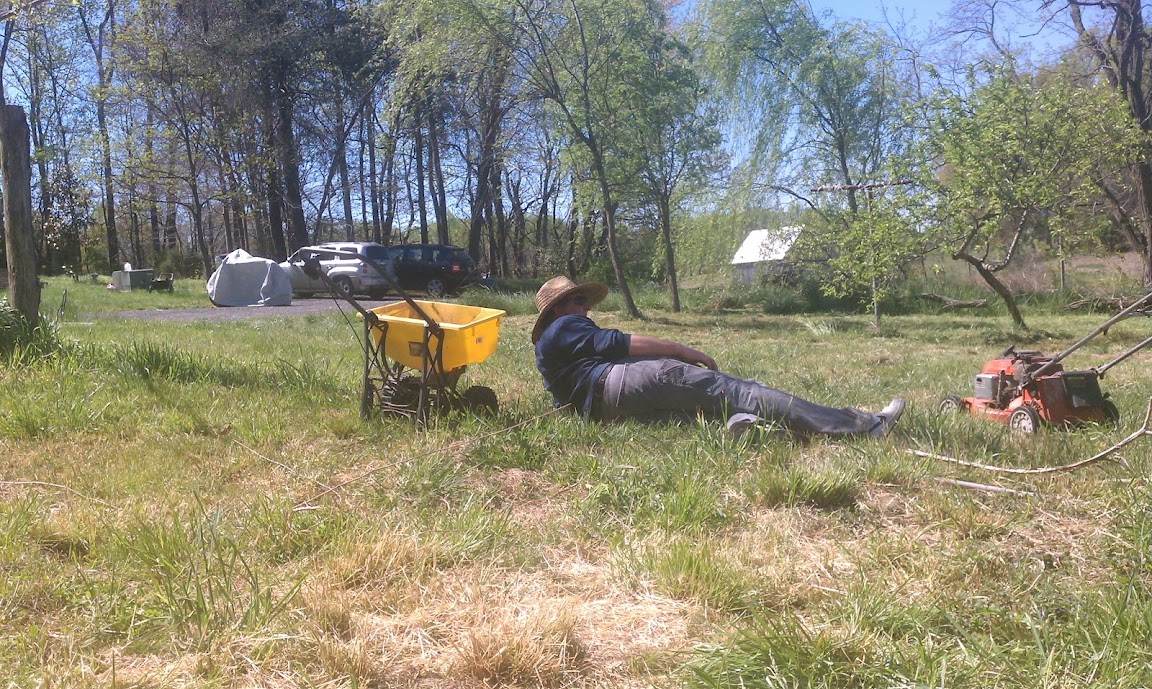
...we spread Milky Spore all around them. Lucky for us, the previous owners had left us both a lawnmower and a drop spreader...but after pushing them around, it was time for a break.


We bought the bush hog and the blade at Marlboro Trading Post, and they were so helpful, we went back and bought a Leinbach L7200 JR auger from them as well.


They even took a look at our "new" tiller, pointed out most of what was wrong with it, and GAVE us a can of ZAP45 spray penetrating oil. In short, it's a hunk of rust, but we might be able to get it to work, they said.

Well, the tiller end of the PTO shaft seems permanently attached. I haven't made any progress on it. But we got the telescoping shaft free (I danced around the yard, waving the freed piece over my head like Beowulf with Grendel's arm), and got the tractor end loosened up, including the bearings INSIDE the PTO connector (get a piece of 1.25"x.25" welding steel, and a hammer. Use your imagination). Soaking the PTO connector in kerosene for 3 or 4 days may have helped...

We greased the u-joints and topped off the oil on the bush hog, then mowed us a patch for our garden. That pretty much finished Saturday.

Easter Sunday began with a beautiful sunrise. Christ has risen!


We attended Easter services, and then went to pick up...

NEW BEES!

This afternoon I reassembled the tiller, greased the PTO, and checked the oil. It's ready to go, I think. Sometime this week, we will have tilled the garden.

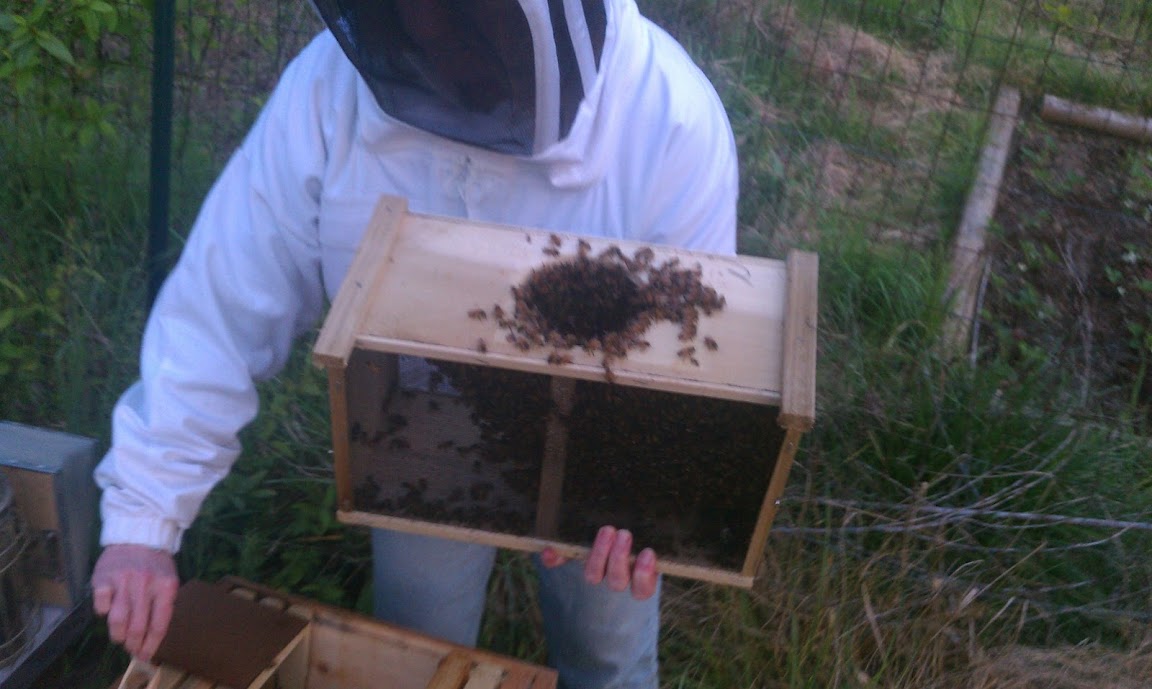
Then we installed the new bees. This time, the queen is marked with a white dot, so she'll be easier to find. We have cleaned out the hives, and we're hoping first, to have bees that MAKE SOME HONEY this time, and second, to keep them alive and unpoisoned.


At least one bee went up each of my pant legs. I came back inside to write this blog entry, and at least one came in with me. Now I am experiencing phantom creepy-crawlies. No stings, I think.

And now Debbie is ordering fruit trees. We'll use the auger to make holes to plant them. We're getting more done this year than last--partly because Debbie is feeling so much better, and partly because we have more of the TOOLS we need.

It has been a VERY busy weekend here at Honeyhill.

Tomorrow is Sadie's follow-up appointment with the vet after her kidney failure in October. We'll let you know...

Tuesday, March 20, 2012

Potato Barrels

We've started playing in the dirt again!

Debbie has started 128 pots of seeds in the house. Steven has been buying toys to plow the fields. And we took the advice of Mother Earth News and started 2 Potato Barrels.

http://www.motherearthnews.com/do-it-yourself/no-space-potato-barrel-ze0z11zkon.aspx

We bought a couple plastic garbage cans at our local big box hardware store, drilled some holes in the bottom for drainage, and put down a layer of soil. Then we added seed potatoes (Yukon Gold, Red Kennebec, and something purple and exotic), and another layer of dirt.

We'll let you know how this goes!

TOYS!

Steve got an unexpected bonus at work last month. Debbie said, "Go buy yourself something fun! You never spend money on yourself!"

So he did.

He went out and bought himself a KingKutter L-60-40-P-Y bush hog:


And a Woods RB60 blade:


And a John Deere 5 foot tiller of unknown model:


And now he gets to ride the tractor some more!

Bees, Redux

And then there were none.

They had food in the hive which they never touched. They just...died, shortly after it started to warm up.

So now, we have NO hives of bees. We are going to remove ALL the old wax, all the little bee bodies, and clean the interior of the hives. There's nothing apparently wrong with the bees in the hive, except for being dead. Again, we suspect poison.

And behold!
http://abcnews.go.com/blogs/technology/2012/03/honeybee-deaths-linked-to-corn-insecticides/

Honeybee Deaths Linked to Corn Insecticides

What was killing all those honeybees in recent years?  New research shows a link between an increase in the death of bees and insecticides, specifically the chemicals used to coat corn seeds.

The study, titled "Assessment of the Environmental Exposure of Honeybees to Particulate Matter Containing Neonicotinoid Insecticides Coming from Corn Coated Seeds," was published in the American Chemical Society's Environmental Science & Technology journal, and provides insight into colony collapse disorder.

Colony collapse disorder, or the mass die-off of honeybees, has stumped researchers up to now. This new research may provide information that  could lead to even more answers.

According to the new study, neonicotinoid insecticides "are among the most widely used in the world, popular because they kill insects by paralyzing nerves but have lower toxicity for other animals."

Beekeepers immediately observed an increase in die-offs right around the time of corn planting using this particular kind of insecticide.

Pneumatic drilling machines suck the seeds in and spray them with the insecticide to create a coating before they are planted in the ground. Researchers suspected the mass die-offs could have been caused by the particles of insecticide that were released into the air by the machines when the chemicals are sprayed.

The researchers tested several methods to make the drilling machines safer for bees. However, they found that all variations that used the neonicotinoid insecticides continued to cause mass die-offs of bees.

Honeybees are critical for pollinating food crops. Scientists say the disruption of pollination could dramatically affect entire ecosystems. In addition, as the researchers wrote in the study, "In view of the currently increasing crop production, and also of corn as a renewable energy source, the correct use of these insecticides within sustainable agriculture is a cause of concern."